
Dominus Columbia
Dominus Columbia was, before its collapse, a reclusive economic powerhouse rivaling the collective strength of Old York, the Iron Works, and the Aysea combined. Built beneath the ruins of the old capital on the foundations of the Eagle Mon cryogenic facility, the buried ring city served as the hub of the Trade Union's caravan network, the seat of the Council of Senators, and the home of the Athenium Mortis Amaranthine. Its catacombs held pre-fall military surplus, technical production techniques thought lost to the ages, and thirty-three volumes of scientific records documenting the origin of the Infection itself. Above ground, City Center's National Keep presented stark stone buildings, outdoor gardens lined with elm and maple, public markets, and family homes called Keeps, all decorated in enduring materials: stone mosaics, metal sculptures, paintings sheltered from weathering. A plaque near the entrance read, "Things are kept simple here so that our minds are not cluttered with distractions."
Below City Center, the Complex adapted pre-fall underground business corridors and transportation tunnels into a functioning subterranean society. Genjian precursors, workers who had tended the cryogenic pods for generations, evolved underground long before the Full Dead found the tunnels from the surface and joined them. Lascarians followed. Fed by underground springs, cooled by natural thermal dynamics, and maintained by educated engineers and caretakers, the Complex expanded outward through the Dupe Circle: a six-mile circulatory loop of underground buildings, stairways, open chambers, and side passages, lit by refracted surface shafts, crude magnetic dynamo lights, and geothermal steam turbines. Stone and concrete walls were painted in warm colors and decorated with mosaic. At its widest, the Dupe Circle opened into auditorium-scale chambers. At its narrowest, six or seven people could walk abreast.
The fall came from inside. The Omni Plague breached containment at the 34th Outbreak Point, a rupture site deep within the Dupe Circle. Contamination spread through the circulatory tunnels with brutal efficiency, reaching every connected layer within hours. The Downtown Complex attempted evacuation through the Security and Enforcement District; most personnel were lost before they reached the exits. The Residential Territory, miles of homes and daily life, converted into diseased crystal reefs. The Vault of the Pre-Fall Burden decompressed, compounding the catastrophe with whatever had been sealed inside. Every system built to circulate resources and maintain order became a vector for plague instead of purpose.
What remains is not a ruin. Dominus Columbia is an active hazard zone operating without oversight, maintenance, or restraint. Automated systems still run. Necrological rituals echo through corridors where no living throat speaks the words. In the Dupe Circle, zombies have fused into the walls and infrastructure, becoming part of the architecture itself. In the Downtown Complex, undead retain fragments of their former roles, performing motions that no longer mean anything. In the deep vaults, entities display traits of multiple archived strain profiles, as if the containment that once separated them has bled together. Temperature shifts sharply between adjacent rooms. Gravity behaves inconsistently near collapsed containment rings. Corrosive vapor fills spaces where administrators once debated policy.
No settlement claims this territory. No faction patrols it. No recovery effort is ongoing. Artifacts removed from the vaults have demonstrated delayed activation and secondary contamination effects, making even successful extraction an existential risk. The city is sealed and monitored from distance by the Greater Bailey Ring. Dominus Columbia did not fall because it was unlucky. It fell because it was built on the premise that containment was the same thing as control, and the systems it designed to circulate life carried death just as effectively.
To the three city-states of the Aysea, northeast of the ruined capital, the fall of Dominus Columbia is both a cautionary tale and a standing expense. The outbreak that gutted the city, dated to roughly 124 to 126 DC, scattered its institutions and some of its survivors outward. The Trade Union, once anchored here, shifted its center of gravity and now keeps its largest base in Harbormarch, where it brokers currency across the Aysea's three branded Chip systems. A portion of every cross-territory exchange fee is quietly understood to fund the fallen city's recovery and what survives of its trade infrastructure, so that a worker changing Harbormarch Chips for Stack issue is, without meaning to, paying into the long project of keeping Dominus Columbia relevant after its decline. The clearest face of that grief is Marcus Oddfellow, the Union's representative in Harbormarch. Once a Senator of real influence in the buried city, he was away at sea running a scrap shipment when the outbreak destroyed it and took his wife and three children, and he has since poured his fortune into holding the quarantine and keeping the Wells, Ossuary, and Blacktide operations solvent. People report finding him near Murder Gardens at strange hours, murmuring at the darkness as though the lost dead of Dominus Columbia were the only listeners whose judgment still counts.
Below City Center, the Complex adapted pre-fall underground business corridors and transportation tunnels into a functioning subterranean society. Genjian precursors, workers who had tended the cryogenic pods for generations, evolved underground long before the Full Dead found the tunnels from the surface and joined them. Lascarians followed. Fed by underground springs, cooled by natural thermal dynamics, and maintained by educated engineers and caretakers, the Complex expanded outward through the Dupe Circle: a six-mile circulatory loop of underground buildings, stairways, open chambers, and side passages, lit by refracted surface shafts, crude magnetic dynamo lights, and geothermal steam turbines. Stone and concrete walls were painted in warm colors and decorated with mosaic. At its widest, the Dupe Circle opened into auditorium-scale chambers. At its narrowest, six or seven people could walk abreast.
The fall came from inside. The Omni Plague breached containment at the 34th Outbreak Point, a rupture site deep within the Dupe Circle. Contamination spread through the circulatory tunnels with brutal efficiency, reaching every connected layer within hours. The Downtown Complex attempted evacuation through the Security and Enforcement District; most personnel were lost before they reached the exits. The Residential Territory, miles of homes and daily life, converted into diseased crystal reefs. The Vault of the Pre-Fall Burden decompressed, compounding the catastrophe with whatever had been sealed inside. Every system built to circulate resources and maintain order became a vector for plague instead of purpose.
What remains is not a ruin. Dominus Columbia is an active hazard zone operating without oversight, maintenance, or restraint. Automated systems still run. Necrological rituals echo through corridors where no living throat speaks the words. In the Dupe Circle, zombies have fused into the walls and infrastructure, becoming part of the architecture itself. In the Downtown Complex, undead retain fragments of their former roles, performing motions that no longer mean anything. In the deep vaults, entities display traits of multiple archived strain profiles, as if the containment that once separated them has bled together. Temperature shifts sharply between adjacent rooms. Gravity behaves inconsistently near collapsed containment rings. Corrosive vapor fills spaces where administrators once debated policy.
No settlement claims this territory. No faction patrols it. No recovery effort is ongoing. Artifacts removed from the vaults have demonstrated delayed activation and secondary contamination effects, making even successful extraction an existential risk. The city is sealed and monitored from distance by the Greater Bailey Ring. Dominus Columbia did not fall because it was unlucky. It fell because it was built on the premise that containment was the same thing as control, and the systems it designed to circulate life carried death just as effectively.
To the three city-states of the Aysea, northeast of the ruined capital, the fall of Dominus Columbia is both a cautionary tale and a standing expense. The outbreak that gutted the city, dated to roughly 124 to 126 DC, scattered its institutions and some of its survivors outward. The Trade Union, once anchored here, shifted its center of gravity and now keeps its largest base in Harbormarch, where it brokers currency across the Aysea's three branded Chip systems. A portion of every cross-territory exchange fee is quietly understood to fund the fallen city's recovery and what survives of its trade infrastructure, so that a worker changing Harbormarch Chips for Stack issue is, without meaning to, paying into the long project of keeping Dominus Columbia relevant after its decline. The clearest face of that grief is Marcus Oddfellow, the Union's representative in Harbormarch. Once a Senator of real influence in the buried city, he was away at sea running a scrap shipment when the outbreak destroyed it and took his wife and three children, and he has since poured his fortune into holding the quarantine and keeping the Wells, Ossuary, and Blacktide operations solvent. People report finding him near Murder Gardens at strange hours, murmuring at the darkness as though the lost dead of Dominus Columbia were the only listeners whose judgment still counts.
Maps
-

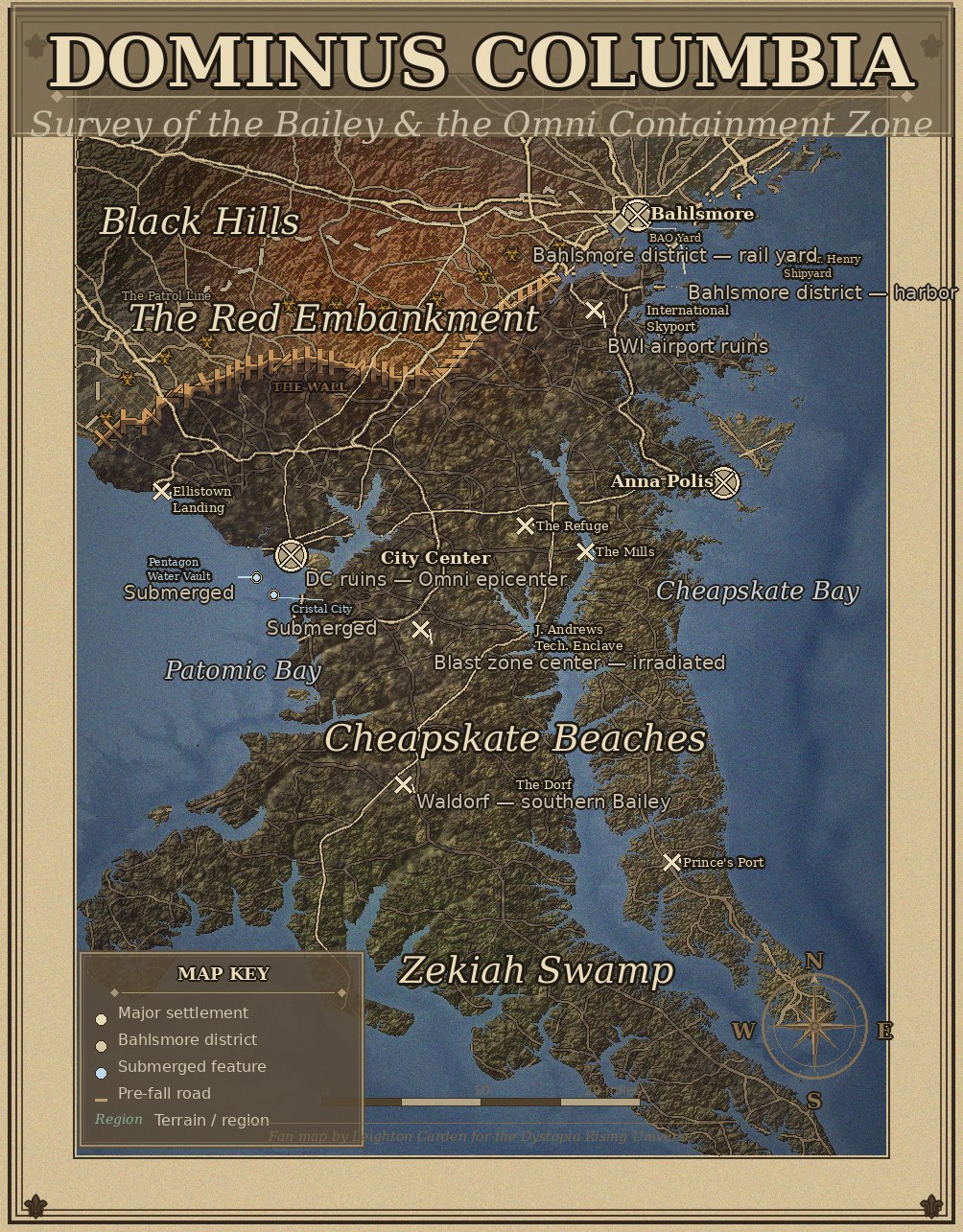
Map of Dominus Columbia
The Peninsula of Dominus Columbia
Type
Geopolitical, City-state
Alternative Names
Dee Cee, Herrod's Kingdom (Archaic)
Demonym
Columbians
Ruling Organization
Founders
Subsidiary Organizations
Location
Controlled Territories
Notable Members
Known Criminal Organization
Dominus Columbia attempts to keep an eye on known Trade Princes, and it is not uncommon for less crime-friendly towns to hassle or even arrest their known henchmen on sight.
